What is a Trust (Really)? A Simple Introduction for Property Investors
Most high-income professionals hear the word “trust” often, but very few understand what it actually means. It appears in conversations like:
“You should buy your investment property in a trust.”
“Trusts help with tax planning.”
“A trust will protect your assets.”
But very few people can explain, in plain English, what a trust actually is.
In this article, we take a calm, simple look at trusts without jargon so you can understand whether they belong in your wealth story.
A trust is not a thing you own. It is a relationship.
The best way to understand a trust is this:
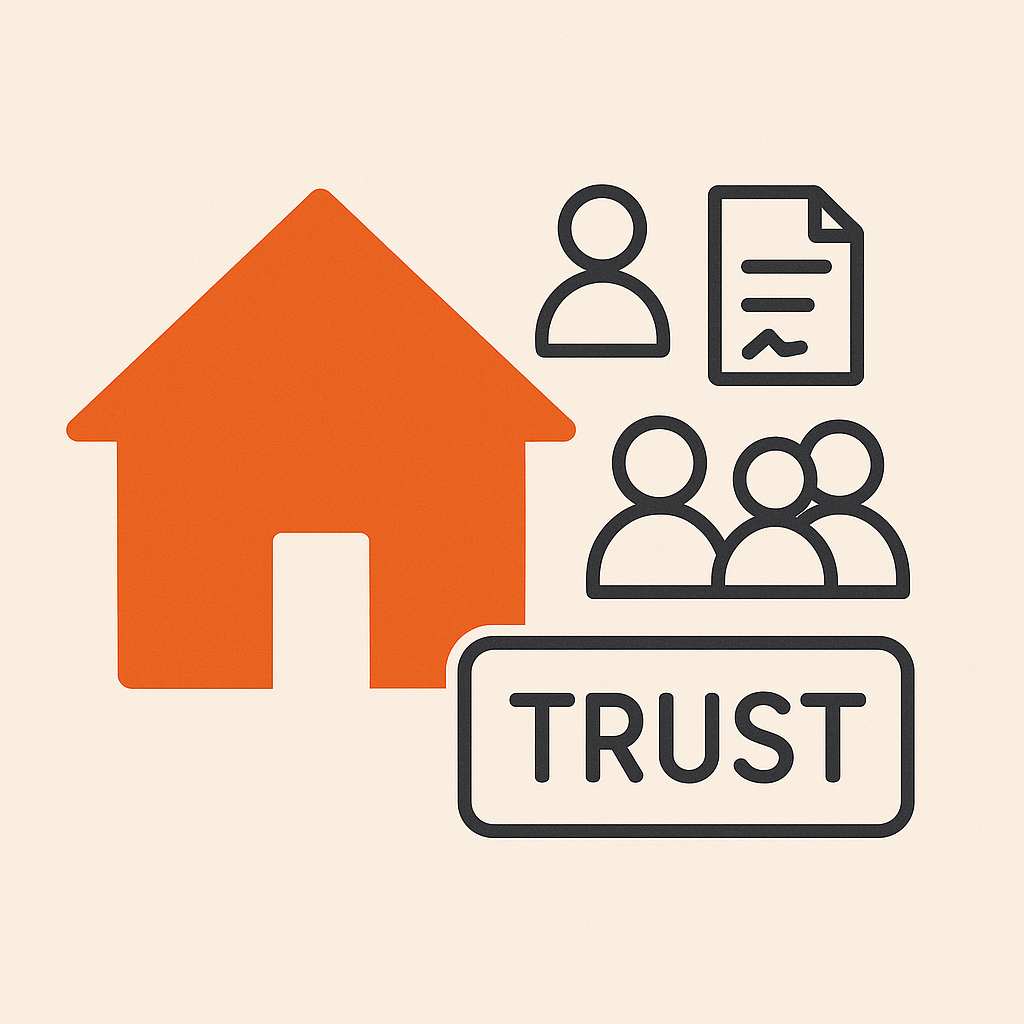
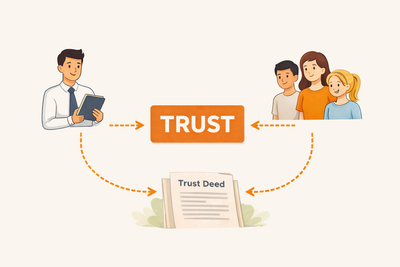
A trust is a legal relationship where one person holds something for the benefit of someone else.
There are three characters involved:
1. The trustee: controls the asset. This can be an individual or a company (with you as director).
2. The beneficiaries: receive the benefit. The trustee can also be a beneficiary, along with your family members.
3. The trust deed: the rulebook that sets out how the trust must operate.
If you buy a property in a trust, the title is not in your name. It is in the trustee’s name, held on behalf of the beneficiaries. This surprises a lot of people. A trust is not a company and it is not a person. It is an agreement that defines who controls an asset and who benefits from it.
Why high-income professionals use trusts
Most professionals consider trusts for three reasons:
1. Flexibility in distributing income
2. Potential tax efficiency
3. Some level of asset protection
But none of these are automatic. Each benefit depends on the trust structure, the trust deed, and how the trust is managed over time.
A simple real-life scenario
Let us say David is a surgeon earning $420,000 a year. His spouse Anna works part-time earning $45,000. If David bought a $700,000 investment property in his own name, all rental income, say $25,000 a year (ignore deductions for simplicity), would be taxed at his marginal rate of 45%.
But if the property sits inside a discretionary trust, and Anna is a beneficiary, the trustee may choose to distribute the rental income to Anna instead. At Anna’s tax rate, the tax outcome looks very different.
This flexibility is what attracts many high-income families to trust structures.
But here is something most people do not realise
The flexibility to distribute income is not unlimited. The trustee must follow the trust deed, must make distributions correctly each year, and must document those decisions properly. A distribution is not simply “choosing” to allocate income, it is a legal obligation that must be made in accordance with the deed and tax rules. Poor paperwork or late decisions can undo the intended tax planning.
When a trust does NOT help
Trusts are often misused or chosen for the wrong reasons.
A trust may not be suitable if:
• You plan to buy only one property
• The property will be negatively geared
• Your state charges high land tax on discretionary trusts (such as Victoria)
• You want a simple, low-cost structure
A trust is a tool. It works beautifully in the right situation and poorly in the wrong one.
No spam, no sharing to third party. Only you and me.


Member discussion