How Super Really Works as a Wealth-Building Tool

Superannuation is often described as something you worry about later in life. Retirement. Old age. A distant future version of yourself.
That view is understandable, but it misses something important.
Super is not just a retirement account. It is one of the most powerful long-term wealth-building tools available to Australians, especially professionals with stable incomes. The reason is simple. Super operates in a low-tax environment, and over time, tax efficiency matters more than almost anything else.
To use super effectively, however, you first need to understand how contributions actually work. Once that is understood, many of the decisions around super become much clearer.
Why Super Matters More Than You Think
At its core, superannuation is a structure designed to encourage long-term saving by taxing money more gently than it would be taxed outside the system.
Most income you earn personally is taxed at your marginal tax rate, which for many professionals sits between 37% and 47%. Money that flows into super, on the other hand, is generally taxed at 15%. Investment earnings inside super are also taxed at 15%, and potentially less once you move into retirement phase.
That difference compounds quietly over decades.
Before you can take advantage of this, though, you need to understand the different ways money can enter your super fund.
The Two Types of Super Contributions
All super contributions fall into one of two broad categories. The difference between them is not just technical. It directly affects how much tax you pay.
Concessional Contributions
The first category is concessional contributions. These are contributions made from income that has not yet been taxed at your personal rate. Your employer’s compulsory super contributions fall into this category. If you choose to salary sacrifice, those amounts are also concessional. Personal contributions for which you later claim a tax deduction are also concessional contributions.
Because this money has not been taxed in your hands, it is taxed at 15% when it enters your super fund.
Non-concessional Contributions
The second category is non-concessional contributions. These are contributions made from money that has already been taxed at your personal tax rate. Because the tax has already been paid, these amounts are not taxed again when they go into super.
Understanding which category a contribution falls into is critical, because each category has its own limits.
Contribution Caps (Limits) and Why They Exist
To keep the system fair, the government places limits on how much you can contribute to your super each year.
For concessional contributions, the annual cap is $30,000 from 1 July 2024. This cap includes everything. Employer super guarantee amounts, salary sacrifice contributions, and any personal contributions for which you claim a tax deduction all count toward this single limit.
This often surprises people. Many professionals assume their employer contributions sit separately, but they do not. Everything adds up to the same cap.
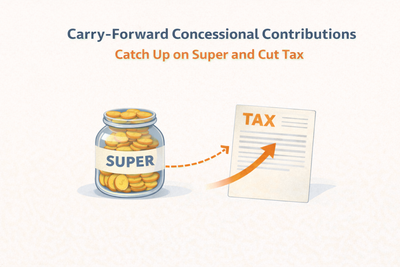
There is also a useful rule that many people miss. If you do not use your full concessional cap in a year, you may be able to carry forward the unused amount and use it later. Unused concessional cap amounts can only be carried forward for five financial years, and they expire after that. You can generally only access this carry-forward rule if your total super balance is under $500,000 at 30 June of the previous financial year.
For non-concessional contributions, the annual cap is $120,000 from 1 July 2024. These contributions are made from after-tax money and do not provide a tax deduction. They simply move money into the super environment where future earnings are taxed more gently.
Why Concessional Contributions Are So Powerful
The real strength of super lies in concessional contributions.
When you make concessional contributions, you are effectively shifting income that would have been taxed at your marginal rate into an environment where it is taxed at 15 percent. For someone earning $180,000 or more, that difference can be significant.
Over time, the lower tax on both contributions and investment earnings allows more of your money to stay invested and compound. This is not about chasing high returns. It is about letting tax efficiency do its quiet work in the background.
How Super Fits Into Your Wealth Story
Super is not an all-or-nothing decision. It sits alongside other parts of your financial life, such as property, investing outside super, and cash flow management.
For many professionals, super becomes the foundation. It is the place where long-term money grows steadily, with fewer distractions and less temptation to tinker. Other investments can then be layered on top, depending on goals, risk tolerance, and lifestyle choices.
The key is understanding the rules well enough to use super deliberately, rather than treating it as something that happens to you automatically.
Final Thought
Superannuation works best when it is understood, not ignored.
Once you understand how contributions work, how they are taxed, and how the caps apply, super stops feeling restrictive and starts feeling purposeful. It becomes a tool you can use intentionally in your wealth story, rather than a black box you hope will work out.
In future articles, we will explore how to optimise contributions, use unused caps, and decide when super should take priority over investing elsewhere.
No spam, no sharing to third party. Only you and me.



Member discussion