How to Use Carry-Forward Super Contributions to Catch Up and Save $20,000+ in Tax
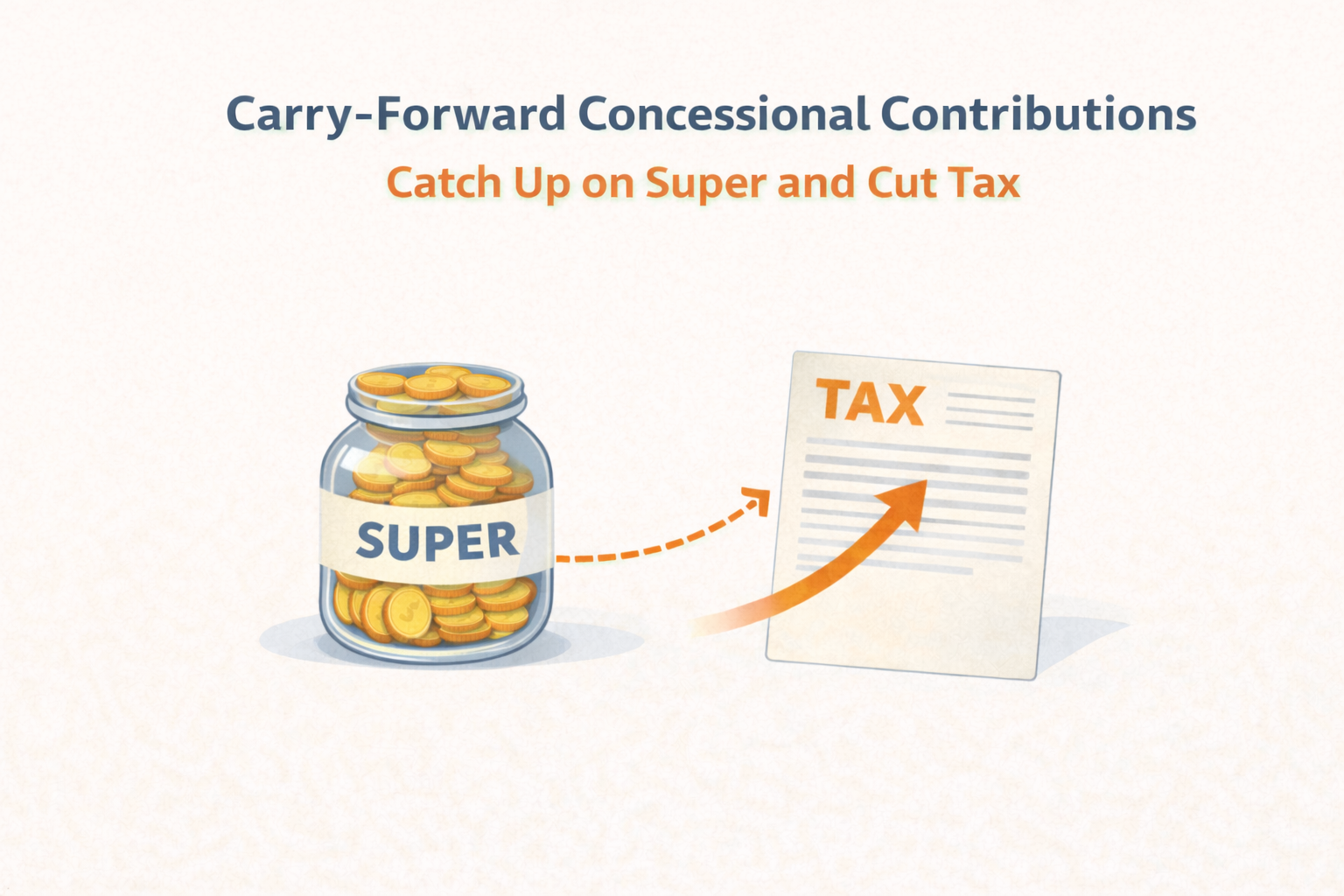
A friend of mine, Aari mentioned he got a $25,000 bonus this year. Great news, right? Except he was stressed about the tax bill.
I asked: "Have you used your carry-forward super contributions?"
Blank stare.
"Your what?"
Turns out Aari had been so focused on paying off his mortgage for the past four years that he never maxed out his super contributions. He had about $35,000 of unused concessional caps just sitting there, expired in two years if he didn't use them.
We did some quick math on my phone. If Aari used carry-forward properly, he could save thousands in tax this year and significantly boost his super balance.
He had no idea this was even possible.
If you're earning good money but have been too busy to think about super for the past few years, this might be the most valuable tax strategy you're not using.
What Is Carry-Forward? (The 90-Second Version)
Every year, you get a limit on how much you can contribute to super as concessional (before-tax) contributions. For 2024-25, that limit is $30,000.
Most high earners don't use the full amount. You're busy. There's a mortgage, school fees, maybe a business to run. Super feels like something you'll "get to later."
Here's what most people miss: those unused amounts don't vanish.
The Australian Tax Office lets you carry them forward for up to 5 years and use them when it actually suits you—like in a big bonus year.
Two rules determine if you can use this:
- Your total super balance must be under $500,000 on 30 June of the previous financial year
- You can only go back 5 years (older unused caps expire)
That's basically it. If you meet those conditions, you can load up a larger contribution in a high-income year and claim the tax deduction.
Why This Matters More When You're Earning $150K+
Let's talk numbers.
If you're earning $180,000, every dollar you shift into super as a concessional contribution saves you roughly 37 cents in tax (depending on your exact marginal rate and Medicare levy).
That same dollar then enters your super fund, where it's taxed at just 15%.
The gap between 37% and 15% is where the benefit lives.
This strategy gets really interesting in specific situations:
- You receive a large bonus (like Aari)
- You sell a business or investment property
- You're a contractor with a lumpy income year
- You're approaching 50 and retirement suddenly feels real
In any of those scenarios, being able to contribute $50,000, $70,000, or even $120,000 into super (by using prior years' unused caps) can create a material difference to both your tax bill and retirement savings.
Real Example: How Marcus Saved $21,000 in Tax
Let me show you how this works with actual numbers.
Marcus is 46. He's a civil engineer earning $195,000 per year.
For the past four years, Marcus has been renovating his house and dealing with expensive private school fees. His employer contributed the mandatory super (about $22,000-ish per year), but Marcus never added extra through salary sacrifice.
Each year, Marcus had roughly $8,000 of unused concessional cap. After 4 years, $32,000 sitting there unused.
This financial year, Marcus's firm paid out bonuses. His total income jumped to $265,000.
His accountant suggested, "Let's use your carry-forward caps."
Instead of only being able to contribute this year's $30,000 cap, Marcus could contribute:
- This year's $30,000, plus
- The $32,000 he didn't use over the past 4 years
- Total: $62,000 (after accounting for his employer's contribution this year)
Marcus made a $40,000 personal deductible contribution to his super fund (on top of his employer's $22,000).
Tax outcome: At his marginal rate of roughly 47% (including Medicare Levy), that $40,000 deduction saved him approximately $18,800 in tax.
That money went into his super instead of to the ATO.
Even accounting for the 15% contributions tax inside super ($6,000), Marcus is still about $12,800 better off than if he'd just paid the tax.
Plus, his super balance jumped by $62,000 in one year.
That's the whole point of this strategy. You catch up when the numbers work in your favor.
The 4 Ways People Accidentally Screw This Up
I've seen this go wrong enough times that I can predict where it'll break. Here's what to watch for.
Mistake 1: Forgetting employer super counts against your cap
This is the most common one.
Someone hears they can contribute $30,000 (or more with carry-forward) and thinks, "Great, I'll just transfer $30,000 from my bank account."
But everything goes into the same bucket:
- Your employer's compulsory super
- Salary sacrifice amounts
- Personal deductible contributions
If your employer is already putting in $21,000, and you contribute another $30,000, you've just exceeded your cap by $21,000.
The ATO will tax that excess at your marginal rate plus an interest charge. Painful. Avoidable.
Always calculate your employer's contribution first, then work out what's left.
Mistake 2: Assuming you qualify without checking
The $500,000 total super balance test is not negotiable.
If your balance was $500,000 or more on 30 June last year, carry-forward is off the table this year. Doesn't matter how much unused cap you have sitting there.
This catches a lot of people in their early 50s who've been steadily building super for decades. They discover carry-forward, get excited, then realise they're $20,000 over the threshold.
Check your balance before you plan anything.
Mistake 3: Leaving it to the last week of June
If you're making a personal contribution (not through your employer's payroll), your super fund needs time to receive and process it.
I've seen people transfer money on June 28th and just hope it gets allocated to the right financial year.
Sometimes it works. Sometimes it doesn't. When it doesn't, you've just made a non-concessional contribution by accident, which has completely different tax implications.
Do this by mid-June at the latest. Give yourself buffer time.
Mistake 4: Skipping the "notice of intent" paperwork
If you're making a personal contribution and want to claim the tax deduction, you must lodge a notice of intent to claim a deduction with your super fund.
You need acknowledgment from the fund. And you need to do this before you lodge your tax return.
Skip this step and you can't claim the deduction. The money still goes into super, but now it's counted as a non-concessional contribution instead. Different cap. Different outcome. Annoying.
Most super funds have a simple online form for this. It takes 5 minutes. Just don't forget to do it.
How I'd Actually Do This (Step by Step)
If I were using carry-forward for myself, here's exactly what I'd do:
Step 1: Check what's available
Log into myGov → ATO online services → Super → Check my unused concessional cap amounts.
The ATO tracks this automatically. You'll see exactly how much unused cap you have from each of the past 5 years.
Step 2: Confirm I'm under the $500k threshold
Check my total super balance as of 30 June last financial year.
Over $500k? Strategy doesn't apply. Under? Keep going.
Step 3: Calculate employer contribution
Work out what my employer will contribute this year. Usually about 12% of ordinary time earnings.
For example: $180,000 salary × 12% = $21,600.
That $21,600 counts toward my cap before I even do anything.
Step 4: Decide how much extra to contribute
If my cap is $30,000 and my employer contributes $21,600, I have $8,400 of space left this year.
If I have $25,000 of unused carry-forward, I could contribute up to $33,400 total ($8,400 + $25,000).
I'd decide based on:
- How much cash flow I have.
- What my tax situation looks like.
- Whether Division 293 applies (more on that below).
Step 5: Pick my method
Option A: Salary sacrifice (easier) Set it up through payroll. Check with your HR. The money comes out before I see it. No extra paperwork needed for tax deduction.
Option B: Personal contribution (more flexible) Transfer money directly to my super fund. I need to complete a notice of intent to claim a deduction. Good if I'm a contractor or have variable income.
Step 6: Check Division 293
If my income plus super contributions exceed $250,000, I'll pay an extra 15% tax on the amount over that threshold.
Still probably worth it, but I need to factor this into my calculations.
Step 7: Execute by mid-June
Set a reminder for early June. Get it done. Don't procrastinate until June 29th.
What About Division 293 Tax?
Quick explanation because this trips people up.
If your income plus concessional super contributions go over $250,000, the government charges an additional 15% tax on contributions above that threshold.
Normally, super contributions are taxed at 15%. With Division 293, the portion above $250,000 gets taxed at 30% total.
Example:
- Your income: $230,000
- You contribute: $40,000 to super
- Total: $270,000
The first $20,000 of super contributions gets taxed at 15%. The remaining $20,000 (the part that pushes you over $250k) gets taxed at 30%.
Does this mean carry-forward isn't worth it?
Usually no. Even at 30%, you're still better off than paying your full marginal rate (which could be 45%+).
But you need to do the math properly. Don't just max out your contribution without understanding the tax impact.
When This Strategy Actually Makes Sense
Carry-forward works best when you tick most of these boxes:
✓ You're earning $150,000+ (so the tax arbitrage is meaningful).
✓ You've had 2-3+ years where you didn't max out your super cap.
✓ You have a windfall, bonus, or high-income year.
✓ Your super balance is comfortably under $500k.
✓ You can afford the cash flow hit (you don't desperately need that money for something else).
✓ You're at least thinking about retirement in the next 10-20 years.
Common Questions
Can I use carry-forward if I'm self-employed?
Yes, as long as you meet the $500k balance test and you're making concessional contributions (which you claim a tax deduction for).
What happens to unused caps older than 5 years?
They expire. You can't use them. This is why it's worth checking your unused amounts now. You might have caps expiring soon.
Can I use carry-forward and still make non-concessional contributions?
Yes, they're separate caps. But be careful not to exceed the non-concessional cap ($120,000 for 2025-26, or up to $360,000 if you use the bring-forward rule).
What if I change jobs mid-year?
Still works. Just make sure you track contributions from both employers so you don't accidentally exceed your cap.
Does this work for defined benefit super funds?
It's complicated. Defined benefit funds have different rules. You'll need specific advice.
Before You Act
This article is general information. Your situation is specific.
Super and tax rules are genuinely complex, and mistakes here can be expensive. Before making large contributions or using carry-forward, talk to a qualified tax adviser or financial planner who can look at your actual numbers.
The strategy works. But only if the execution is right.
No spam, no sharing to third party. Only you and me.




Member discussion